
Schuylkill County Council for the Arts

The Yuengling Story:
Family & Mansion History
Preserving the Past & Celebrating the Arts in Schuylkill County | Historic Frank D. Yuengling Mansion

1990

Item 2
Item 2

1960

Item 1
Item 1

The Frank D. Yuengling Family & the Making of a Mansion
In 1913, Frank D. Yuengling—fourth president of America’s oldest brewery—commissioned architect Harry Maurer to design a grand Tudor-Jacobethan Revival home for his family at 1440 Mahantongo Street in Pottsville. Built at a cost of $75,000, the mansion featured over 20 rooms across four floors and included elegant details such as leaded glass windows, carved stonework, pocket doors, and button-style light switches—cutting-edge for the time.
Frank and his wife, Augusta, raised five children in the home, where they employed household staff including a cook, four servants, a chauffeur, and a gardener. The thoughtfully designed property includes a covered portico, formal gardens, and a carriage house, with a driveway accessible from both Mahantongo and 15th Streets.
The Yuengling family lived in the mansion until 1978, when it was gifted to the Schuylkill County Council for the Arts (SCCA) to serve as a center for arts and culture. The home was added to the National Register of Historic Places in 1979 and remains a preserved historic landmark.
Today, thanks to the generosity of the Yuengling family, the mansion continues to welcome the community through arts programs, exhibitions, performances, and events—just as it did over a century ago.
PARLOR AND PHONE ROOM
Visitors are welcomed into the neo-Jacobean–style parlor, the original main entrance used by the Yuengling family. Featuring a grand carved soapstone fireplace with copper fireplace equipment, parquet wood floors once covered with Persian rugs, and an open staircase, this space served—and continues to serve—as a central greeting and gathering place within the home.
The leaded glass doors and stairwell windows, believed to have been crafted in Germany, display city logos and are thought to be imported European artifacts. These windows and the carved fireplace are believed to be European imports from the turn of the twentieth century, a period when American building boomed as Europe faced economic recession.
The foyer’s wood paneling, made from rare cross-cut oak, further enhances the room’s decorative richness. Furnishings such as the leather chairs, settee, mirror, and console table are original to the Yuengling family. The built-in telephone booth once housed a telephone, intercom, and mercury fuse box, serving as an early communication hub for the household.


MUSIC ROOM
Once the heart of the home’s musical gatherings, this space served as the Yuengling family’s music room. Mrs. Yuengling often led songfests at the baby grand piano, bringing together family and friends for joyful musical performances. The family also owned an early 1900s Victrola record player, enhancing their shared love of music and adding to the room’s rich legacy.
Reflecting the home’s feminine architectural influences, the room features a bright Adamesque style. Elegant wall sconces are adorned with Wedgwood medallions, and a sparkling European cut-glass chandelier adds charm from above. The intricately carved fireplace is another focal point, complete with a brass bumper around the marble hearth and a carved wood medallion on the mantel—replacing the original Wedgwood medallion, which cracked from the fireplace’s heat.
FORMAL LIVING ROOM
This elegant formal living room, paneled in solid mahogany with silk tapestry wall coverings depicting a garden scene, exemplifies the refined beauty of neo-Jacobethan architecture. Once considered the formal parlor of the Yuengling Mansion, the room was used only on special occasions and holidays. Augusta Yuengling, the family's only daughter, was married here.
An ornately carved mahogany fireplace mantel, silver andirons and tools, and a graceful chandelier provide an intimate and distinguished atmosphere. The parquet wood floor was typically covered with Persian rugs, carefully placed to follow the room’s blonde wood border. Each set of French doors opens to a picturesque view of the English gardens. In the early 20th century, Mrs. Yuengling hosted summer parties in the gardens. Brass light fixtures in the room are hand-carved, with hand-blown Steuben Glass shades. A call button, located beneath the light switch, was once used to summon servants—one of many found throughout the mansion.
Highlights include a carved mahogany fireplace, silver andirons, a graceful chandelier, and hand-carved brass light fixtures with Steuben Glass shades. French doors open to views of the English gardens, where Mrs. Yuengling hosted summer gatherings. A discreet call button near the light switch once summoned household staff—one of many throughout the mansion.

Butler's Pantry and Kitchen
The butler’s pantry, located between the dining room and kitchen, served as a key working and storage space for the household. Displayed on the shelves are pieces used by the Yuengling family, including the Maiko pattern china by Powell, Bishop & Stonier (England, 1873–1936) and Augusta Yuengling Roseberry’s Bridal Rose Limoges set (France, 1920–1932), along with her sterling silver serving set engraved with her initials “AYR.”
The space also contained many functional features: a large ice-filled refrigerator accessed from the kitchen porch, a dumbwaiter connecting to the wine cellar, and a second-floor laundry chute. Marble countertops and windowsills provided a durable and sanitary work surface.
The kitchen still holds its original black cast-iron stove—half gas and half coal—manufactured by the Bramhall Dean Company of New York and preserved in place due to its historical significance. Floors were originally cork to reduce noise and breakage but were later replaced with quarry tile by the Schuylkill County Council for the Arts. Marble work surfaces and built-in cutting boards further reflect the thoughtful, practical design of this busy service area.
FAMILY DEN
The den was a central gathering space for the Yuengling family. Surrounded by rich oak paneling, it was here that Mrs. Yuengling read to her children and the family spent evenings together listening to radio broadcasts. Below the wood mantel, the hand-designed fireplace tiles were crafted at the renowned Moravian Tile Works in Doylestown, Pennsylvania. The fireplace tools are made of copper and iron, reflecting the fine craftsmanship of the era.
The European leaded glass windows in this room remain a bit of a mystery. While the exact meanings of the etched designs are unknown, some clergy visitors believe they represent religious symbols commonly found in European church architecture. Others suggest they may be watermark-style emblems used by papermakers to “autograph” their creations. Like many rooms in the mansion, the built-in window seat cleverly conceals a radiator, combining comfort with elegance.


Carriage House
The three-story Carriage House was constructed in the Jacobean–Tudor Revival architectural style to complement the grandeur of the estate. During the Yuengling family’s residency, this building functioned as the estate’s garage. The first floor housed the family’s automobiles—primarily Packard vehicles, a luxury automobile brand known in the early 20th century for its craftsmanship, reliability, and prestige.
A built-in car washing system was incorporated into the design, reflecting the modern conveniences available to the family at the time. When arriving at or departing from the estate, the family’s chauffeur, Walter Faust, would collect or drop them off beneath the mansion’s portico, ensuring they were protected from the elements in all weather.
At one point, Mr. Faust resided on the third floor of the Carriage House. His living quarters included a small bathroom and deep window seats set into the dormer windows.
Adjacent to the Carriage House stands an elaborate dog house, which was later repurposed as a playhouse for young Augusta Yuengling, the family’s daughter. While charming, the playhouse was short-lived, as the children soon outgrew the space.
DINING ROOM
The Yuengling family gathered in this room for every meal around a grand twelve-foot dining table. Even after their children moved away, Mr. and Mrs. Yuengling continued the tradition, seated at opposite ends. A servant’s call button beneath the table still remains.
Architecturally, the room shows Adamesque influence, generous proportions, and a bright western exposure through large windows. It was first decorated with pale gray-green paneling and silver-grey wallpaper, accented by a silver chandelier and Steuben glass sconces. In 1929, it was updated with a blue-and-white palette, floral wallpaper, a hand-painted plaster ceiling, and blue velvet drapes, while the bay window features marble panels and an intricate tile mosaic.
Above the fireplace hangs a painting of Mount Vesuvius by American artist J. Frank Copeland (1872–1957), a respected regional painter whose work is held in the Everhart Museum in Scranton and was reportedly a favorite of Mr. Yuengling.

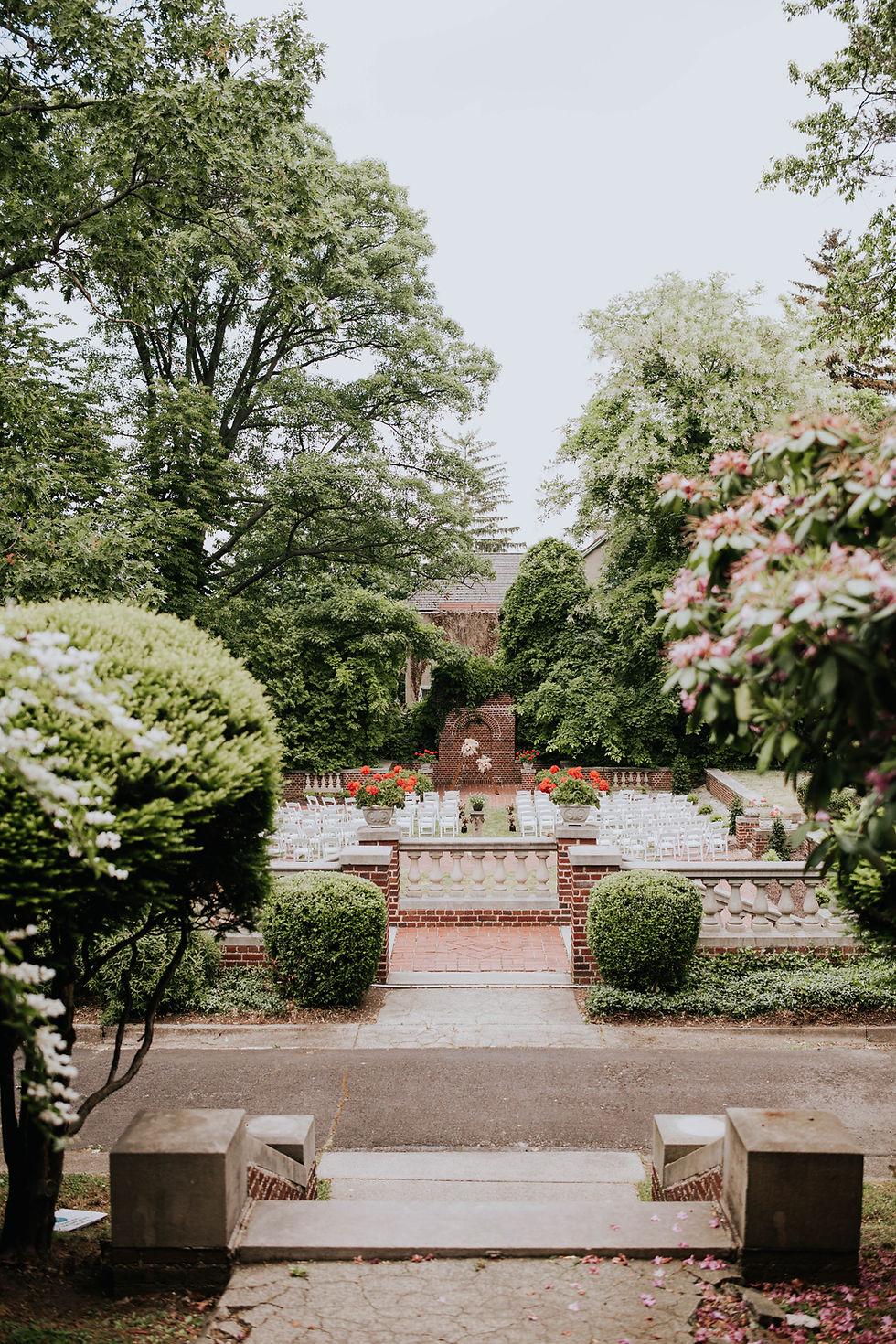
Sunken Garden
The mansion rests on nearly two acres, fully enclosed by a stately cast-iron fence and framed by Mahantongo, Fifteenth, and Norwegian Streets. A winding driveway stretches from the eastern gate on Mahantongo Street, circling the house, and exits at the western gate on Fifteenth Street.
Located at the eastern end of the house, below a balustraded walkway, lies the sunken garden. Originally, it featured decorative statuary, a central sundial, and a beautifully manicured English garden maintained by the family’s gardener, Raymond. On the far eastern end once stood a small gazebo adorned with decorative bas-relief panels; though the original no longer remains, there are plans to recreate it in the future. Surrounded by lush trees and vibrant flowers, the garden was constructed shortly after the family moved in. It was here that Mr. and Mrs. Yuengling’s daughter, Augusta, celebrated her wedding in 1932 to Mr. Louis Norman Ulmber.
Mrs. Yuengling often entertained in the garden, hosting her beloved strawberry festival and weekly card games with friends. Today, the garden continues to delight visitors as a favored venue for weddings, community gatherings, and special events.